OpenRarity, explained: how GARU scores rarity
Why a trait's rarity comes from how often it actually appears, and how GARU ranks every token in your batch.
In short
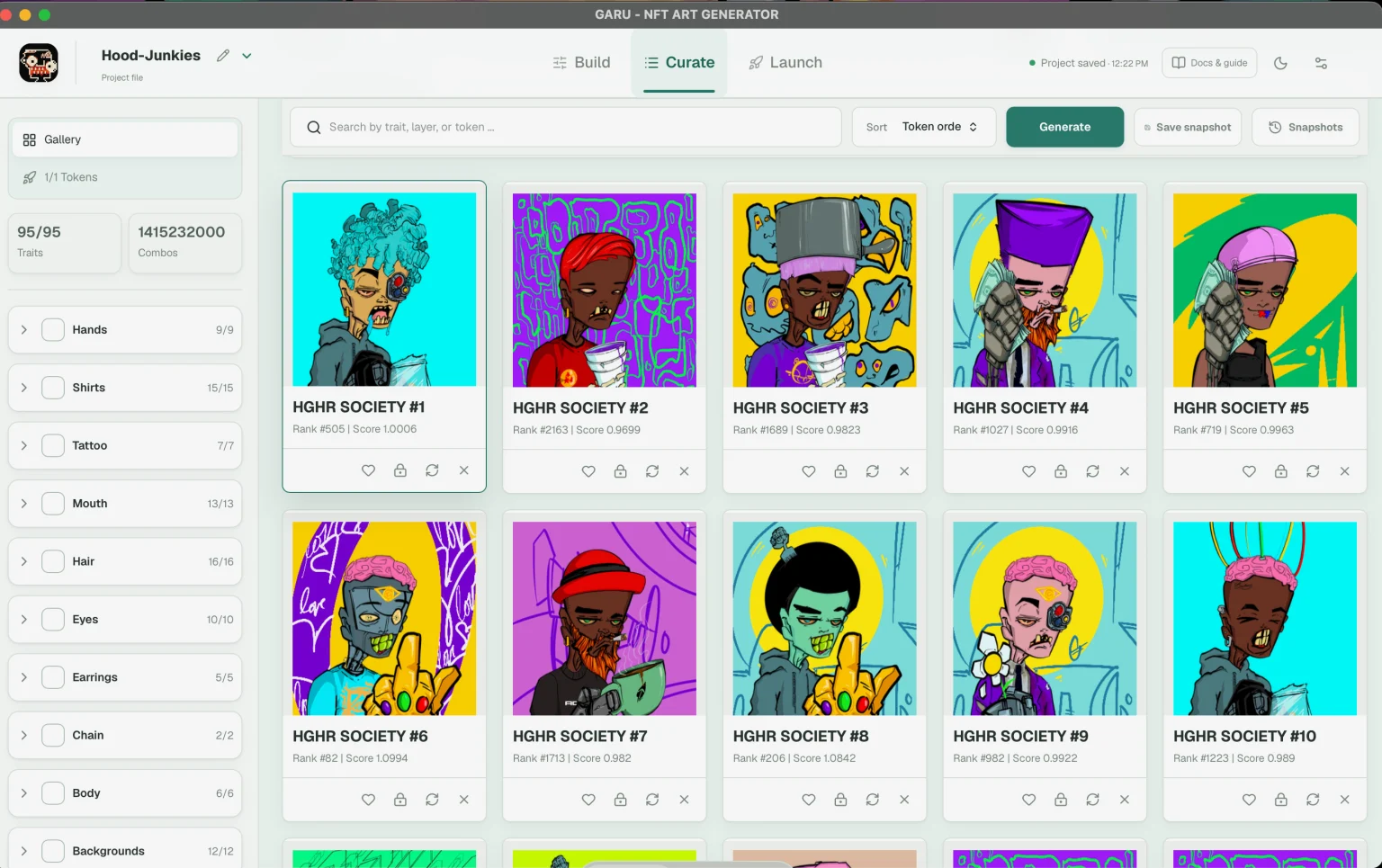
GARU ranks rarity the OpenRarity way. It counts how often each trait really appears in your generated batch, scores every token by how surprising its traits are, and ranks tokens with unique traits first. The score comes from the finished collection, not from the rarity labels you set while building.
Ask ten NFT sites how rare a token is and you can get ten answers. OpenRarity is an open standard that gives one answer, based on maths anyone can check. GARU uses it to rank every token in your batch.
The short version
A trait is rare if few tokens have it. A token is rare if its traits, taken together, are surprising. OpenRarity turns that "surprise" into a number, and GARU ranks your tokens by it.
Step 1: count what actually appeared
After you generate, GARU counts how many tokens have each trait, like Hat: Crown or Eyes: Laser, across the whole batch. It includes your saved 1/1 tokens in the count, because their traits will be exported with everything else.
This is the key idea: rarity comes from the finished collection, not from the tiers you set in Build. If you marked Crown as Mythic but it landed on 400 tokens, it's scored as a trait on 400 tokens. Your tiers and weights shape the generation. The result decides the score.
Step 2: score each trait by how surprising it is
For each trait, GARU works out its *information content*:
information content = -log2(tokens with this trait / total tokens)That sounds technical, but it behaves the way you'd expect:
| Trait appears on | Share of 10,000 | Information content |
|---|---|---|
| 5,000 tokens | 1 in 2 | 1 |
| 625 tokens | 1 in 16 | 4 |
| 10 tokens | 1 in 1,000 | about 10 |
Each halving of how common a trait is adds one point. A 1-in-1,000 trait is worth about ten times a coin flip, not five hundred times, so one rare trait can't drown out everything else on the token.
Step 3: add it up and normalize
A token's raw score is the sum of its traits' information content. GARU then divides by the collection's *entropy*, a measure of how varied the whole collection is. That turns it into a unitless score that reflects how unusual the token is within your collection.
Step 4: rank, with unique traits first
Ranking follows OpenRarity's order:
- Unique traits first. A token with a trait no other token has outranks a token without one, whatever their scores. Two uniques beat one.
- Then by score, highest first.
- Ties share a rank. If two tokens tie for 2nd, the next token is 4th (1, 2, 2, 4). Scores that agree to about nine decimal places count as a tie.
What this means while you build
- Tiers are a plan, not a promise. Check the real count of each trait in Curate's Analytics before you trust its rarity.
- Rare needs room. A trait on 3 tokens in a 10,000 collection will rank high. The same trait on 3 tokens in a 100 collection is far less special.
- 1/1s shift the scores. Adding one-of-one tokens adds their traits to the counts, so the ranks of generated tokens can move.
FAQ
Is GARU's rank the same as OpenSea's?
GARU follows the OpenRarity reference method, which OpenSea has also used. Marketplaces can change how they display rarity, so a rank on a marketplace can differ from GARU's.
Do 1/1 tokens get a rank?
No. 1/1s aren't random layer combinations, so they don't get a rank. Their traits still count toward everyone else's scores.
What about tokens missing a trait?
In GARU every generated token has one trait from every category, so missing traits don't come up. To have "no hat", add a transparent "None" trait and weight it like any other.
Next step
Generate a batch and sort Curate by rarity to see the ranks. For the full detail, read the rarity model reference.
Keep reading